Monday, May 13, 2013

Experience with S.S. Methods


What I gained from the Social Studies Methods course are the five important components of teaching Social Studies, which are meaningful, value-based, integrative, challenging, and active. I learned how to teach a differentiated instruction with the use of indirect inquiry and cooperative lesson plans. The inquiry method is a method that can be implemented within classrooms to promote students learning through the use of exploration. The cooperative strategy encourages students to learn through an activity that promotes socialization and collaboration skills. Both strategies foster students critical thinking and problem solving skills because they are active participants of activities.

Some successes I have gained from this course are how much I have gained from the fieldwork experience,  as well as how to implement particular activities, such as the artifact bag and scavenger hunt, within my future classroom. Some challenges that I was faced with during this course are that it was all based on technology. I am not the most technology-savvy person of all; therefore, this course was rather complicated for me. But, with experience and practice, I got the hand of using Eclass, WebQuest, Wiki, as well as other computer software programs. This course has truly enriched my abilities to manipulate technology, and I will definitely use these methods in my future career as a teacher. 

I am would to create a Social Studies classroom that promotes students' learning by promoting inquiry, social, collaboration, cooperation skills. As well, I want to comprise a classroom that makes students excited to come and learn, as well as leave the classroom each day with new information. I want my students to see learning as exciting, not as a drag; therefore, my lessons will be differentiated. 

Time to Incorporate!


Although I was not available due to inclement weather, from what my fellow peer teachers have told me, the students did meet their objectives for this lesson. The students displayed adequate understanding of the new business terms they learned, which included logo, slogan, capital, stock, and incorporate. For example, the students were able to name many different famous company logos and slogans. The students’ strengths consisted of understanding the new vocabulary terms, as well as designing their company names, logos, and slogans. The challenges that occurred for the students were the specific terms of capital, stock, and shares. These are difficult words to understand; therefore, thorough explanation of the terms was necessary for the students to understand their meanings effectively. With the use of visual representations, such as the pie chart, the students were able to understand the concept of the difference between stocks and shares. For example, the teacher referred to the stock pie chart as a pizza pie; the entire pizza is made up of ten slices resembles stock, while the pieces of the pizza resemble the shares. Students were able to contribute their individual ideas and develop their understanding of logos and slogans independently. Dependently, the students were able understand the concepts of stocks, capital, and incorporate. The challenges that occurred were the groups agreeing on the company name, logo, and slogans. Many disputes occurred and the students’ conflicts were required to be resolved with the assistance of the teachers.  

Exploring Movie Companies


The learners did meet the objectives for this lesson, which included implementing the already known terms to the activity, answering the questions in the movie folder correctly, and follow the inquiry steps accordingly. The strengths that the students displayed were the ability to follow the inquiry process and peruse the information to find the correct answer to the questions. For instance, the students were able to form a question, create a hypothesis, gather data, as well as form a conclusion of whether or not the movie was a success. The challenge that occurred was the question “How much profit did the movie make?” because the answer was not readily available to them within the information. They had to find the amount of revenue the movie made and the expenses  it cost; then, they had to plug the numbers into the profit equation. The students were able to follow the steps of the inquiry process, contribute their ideas for the inquiry and movie folder questions, as well as find the correct answers within the movie folder independently. Dependently, the students were able to discover the steps of the inquiry process and answer the equation pertaining to how much profit the movie made. The challenge that occurred is that although each student was assigned a specific role, which included task manager, task reader, recorder, manager, time manager, ethics manager, and speaker, a few students were off task during this activity. The students believed since they were assigned a specific job that they did not have to help contribute to the activity by adding input for what the inquiry questions should be and what the correct answers for the movie questions were.

Business Terms

Today, the student’s learned necessary business economic terms, which included business, entrepreneur, revenue, expense, profit, profit equation, and entrepreneurial cycle. The learners did meet the objectives, which included: (1) Given the Given a matching worksheet with seven vocabulary words (business, revenue, expense, profit, profit equation, entrepreneur, and entrepreneurial cycle), the student will match the correct vocabulary term with the correct definition, and (2) Given a profit equation worksheet with three word problems, the student will answer at least two questions correctly. When asked to provide company names, the students displayed their high levels of prior knowledge about already existing companies. For example, a student provided the company name Wii and XBox. The students displayed strength in understanding and comprehending the terms by answering all the matching vocabulary review correctly. Also, the students displayed strengths in their ability to provide the appropriate definition. For example, when the student teacher asked the students to define “business” the student said, “a business is a company that sells items” so the teacher had to clarify that a company can sell services, such as photography, in exchange for money. Although students displayed strength in providing the definition for the economic terms, answering the scenario questions posed a challenge for the students.  For example, when provided with the statement “Wendy was given money for making yard sale posters for her neighbors, she now has revenue” as well as asked to decide whether or not it is an example of revenue, many students said it was not when it, in fact, is an example of revenue.


Sunday, April 14, 2013

Exploring Native Americans


Reflection Paper: Exploring Native Americans
Because “Exploring Native Americans” project entailed in-depth research, it definitely expanded my knowledge about Native Americans because it brought me into their “world;” I learned about the tribes’ history, culture, language, geography, as well as the clothes they wore and the food they ate. Honestly, prior to this project, the only Native American tribe I had some prior knowledge about were the Iroquois. Afterwards, I gained an abundance of information about not only the Iroquois, but also about the Muskogee, Dine, and Tlingit. The pictures really attributed to helping me learn about each tribe, which is why I wish that there were pictures for every tribe within the presentation. By having a visual representation, (include something from book here). Furthermore, by having to physically research the Muskogee tribe, I learned a lot of information more so than I would by simply reading a passage from a textbook. By being exposed to an “exploration” of the Muskogee tribe, learning about the Native American tribes was an engaging, rather than a tiresome, task.
Pedagogical content is when learning is meaningful, integrative, value-based, challenging, and active (8). This assignment is meaningful because it builds upon students’ prior knowledge about Native Americans, as well as forces the students to make meaningful connections between Native Americans and their culture. This assignment is integrative because the social studies, reading, and writing are integrated within the assignment. As well, the use of technology and research are included within the assignment. When learning is value-based, it displays “daily decisions about democratic concepts and principles that respect the dignity and rights of individuals and common goods” (8). This assignment is value-based because by learning about the culture of the Native Americans, students are learning how to respect differences in cultures. Furthermore, by learning about the Indian Removal Act, students learn how this act invaded the “dignity and rights” of the Native Americans because it caused them to lose their land, as well as some aspects from their culture. This assignment was challenging because it entailed in-depth research. In order to find information about the tribes’ history, culture, language, food, clothes, as well as famous individuals from the tribe, extensive research was required because all of the answers were not exactly in front of  your face. For example, when researching the Muskogee tribe, I discovered that Muskogee  was also a location; therefore, when researching I had to be sure I was reading about the tribe rather than the place. This assignment was active because the students worked collaboratively within groups; they made inferences, connections, as well as shared information.
Because the project was adapted for college students knowledge, some adaptations may be required to meet the skill level of 2nd, 3rd, 4th, and 5th grade levels. Firstly, I would not recommend use of technology for 2nd, 3rd,  and 4th graders because the use of computers can pose a distraction. Therefore, I would bring the students on a trip to the library to check out books about their Native American tribes. As for 5th graders, instead of allowing them to have “free range” of the computers, I would have one student from each group to be the computer user and would keep a close eye on the students to make sure they are staying on task. Also, instead of using powerpoint, I would have the students make posters using pictures they draw or print. The posters will be graded on the information, facts, pictures, and neatness. The students will present their projects in class, and their classmates will provide them with feedback - what they like about the project and what they could improve upon. Feedback cannot just be “good job” or “I liked it” because they need to provide the presenters with specific areas they did well on. The national standards that would be addressed are: Understand how culture and experience influence people's perceptions of places and regions, understand how to apply geography to interpret the past, and understand how to apply geography to interpret the present and plan for the future.The state standard that would be addressed is: Students will use a variety of intellectual skills to demonstrate their understanding of the geography of the interdependent world in which we live—local, national, and global—including the distribution of people, places, and environments over the Earth’s surface.
This projects forces students to make generalized concepts regarding geography. By focusing on the five themes, which are (1) Location, Position on the Earth’s Surface, (2) Place, Natural and Cultural Characteristics, (3) Relationships within Places, Humans and Environments, (4) Movement, Humans Interacting with Earth, and (5) Regions, How they Form and Change, students can make the generalization that geography has an impact on culture (373). The geography determines what Native American tribes wear for clothing, what language they speak, what type of housing they live in, as well as what they eat. For example, since the Muscogee largely inhabited in Southeast America (Georgia, Alabama, Florida, and North Carolina), the women were primarily gatherers, harvesting crops like beans, grain, and squash, while the men were hunters.
This project would help students learn geography because it teaches them where each tribe lived. Along with discovering where each tribe lived, it teaches the students about the landscape of the region they lived, such as the major mountains, river, and lakes. For example, the Dine tribes were located in northeast Arizona, northwest New Mexico and southeast Utah, which contained mountain peaks, grasslands, and deserts. As well where the tribes lived determines what types of homes they have because they used the resources of that area, such as the Dine whose homes were made out of sticks, brush, and packed Earth. Along with learning about the geography, it is discovered that the Indian Removal Act forced tribes to relocate; therefore, the students are forced to mentally or physically look at a map to determine the distance they were forced to move.  


Resources
Sunal, Cynthia & Haas, Mary. Social Studies for the Elementary and Middle Grades: a
Constructivist Approach. Pearson Education: New York (2011). Print.


Friday, April 12, 2013

Looking at Robin Hood Through a Historical Lens

Looking at Robin Hood Through Historical Lens


Although many may think of Robin Hood as a mere character individuals know from their childhood, he is actually a particularly historical figure. It is still unknown whether or not Robin Hood resembles any particular historical individual, but it is evident that the plot of the story has a rather historical significance. It is imperative to integrate other subjects into social studies; therefore, the topic I chose to focus on is despite a piece of literature being labeled fiction, authors tend to draw from historical contexts. The students will be given an artifact bag containing items that resemble Robin Hood; the students will have to collaborate the investigate the five W’s (Who, what, where, when, why) of each artifact within the bag. Because this is an investigation, the students will have the ability to research using the computer. The lesson will be taught to is fourth grade, and will focus on the standards are:

  • RH.6-8.1 Cite specific textual evidence to support analysis of primary and secondary sources.
  • RH.6-8.2 Determine the central ideas or information of a primary or secondary source; provide an accurate summary of the source distinct from prior knowledge or opinions.

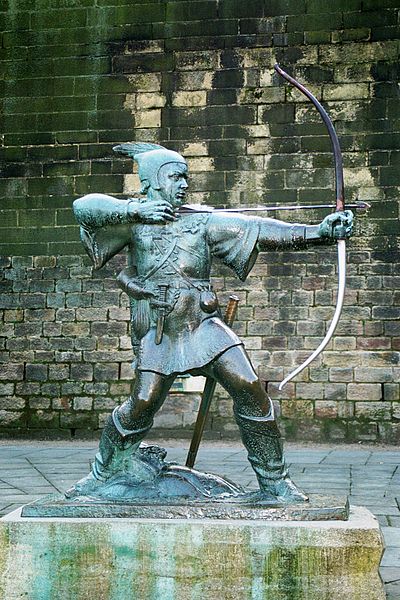
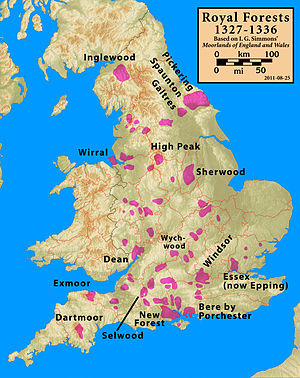
File:Robin Hood Memorial.jpgRoyal.Forests.1327.1336.selected.jpg The artifacts that are in the artifact bag is a drawing of Robin Hood, a picture of a statue of Robin Hood, a map of Sherwood Forest, a feather, a pretend bow and arrow, and a political cartoon. I chose the drawing of Robin Hood (spelt Robyn Hode) is depicted in the oldest surviving tale, known as “A Gest of Robyn Hode,” of Robin Hood dated, which was dated in approximately 1450. I chose the statue of Robin Hood because it is located in the same town Robin Hood was set in, which is Nottingham, England; as well, I chose the map of Sherwood Forest because it is the exact forest where the story of Robin Hood takes place. I chose the feather and the bow-and-arrow because they represent the clothing Robin Hood wears in the book and movie.
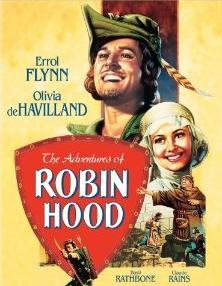
Instead of reading a book, I decided to base my lesson around the movie “The Adventures of Robin Hood” filmed in 1938. I chose Robin Hood because it envelops many historical concepts, such as oppression, taxation, and crusades. Robin Hood encompasses many similarities to Hereward the Wake who led a rebellion against William the Conqueror. The websites that will be used for this lesson is
www.boldoutlaw.com  because is offers information about the ballads and stories, historical figures, and pictures of Robin Hood. As well, the sight offers a few interviews had with Robin Hood scholars, actors, and authors, as well as other resources for further information.


The artifacts, movie, and website tie together because they are all related to Robin Hood whether historically or geographically. Prior to watching the movie, I will activate the students’ prior knowledge by asking questions such as: “What do you know about Robin Hood?” and “What kind of things come to mind when I say Robin Hood?” According to Pearson and FIelding, “Perhaps no other phenomenon has influenced instructional research in the last  decade as pervasively as our increased understanding of the powerful background of knowledge in reading comprehension” (Fuhler 648). Then, the students will watch the movie, and I will point out things that are particularly historical, such as the middle ages, taxation, and crusades. Once the students finish the movie, they will be peruse the website www.boldoutlaw.com for further information, and to prepare for the artifact bag investigation. Before distributing the artifact bag, I will state the directions, which are to unwrap, inspect, and research the items. Furthermore, I will instruct the students to note who, what, where, when, and why about the artifacts. After the students find the information about the artifacts, they will present their findings to their classmates.
Artifact bags are a great way to engage students in history, as well as differentiates instruction so the students have the opportunity to experience something new. Investigating artifacts expose students to the curriculum, but also integrates other curricuar areas, such as reading, writing, and social studies “without anxiety or fear of failure” (Fuhler 646). By investigating the artifacts with the use of internet sources, the students are critically thinking and making connections between the movie and artifacts. Additionally, the artifact bag task forces students to collaborate. Students have to “listen to others,” “give everyone fair chances,” and “agree on ideas” (Sunal 220).  


Here are a few more artifacts that could be used in the artifact bag, as well... 

Live Oaks in Bidwell Park


Picture of where "The Adventures of Robin Hood" was filmed. The location used for Sherwood Forest is Chico, Califonia. 


Robin Hood was filmed is a variety of ways. This particular photo depicts a Robin Hood movie produced by Warner Bros, in which Robin Hood is portrayed by Daffy Duck and Little John by Porky the Pig. 


This is a polical cartoon drawn by John Collins; notice the play on the words "steal from the rich and give to the poor" here. 

Resources: 

Sunal, Cynthia. "Social Studies for the Elementary and Middle Grades" 4th Ed (2011) Allyn & Bacon Inc.: New York, New York. 

C. Fuhler, P. Farris, P. Nelson "Building Literacy skills across the curriculum: Forging Connections with the past through artifactshttp://eclass.msmc.edu/file.php/3186/artfactbag_article.pdf


Robin Hood Resources: Robin Hood Bold Outlaw of Barnsdale and Sherwood (2012) http://boldoutlaw.com/


Tuesday, March 26, 2013

What is Geography?

Geography is literally everywhere, and sometimes we aren't aware that it is; it is what is happening in the world, why it is happening, and how it affects people throughout the world. Geographical knowledge watching the ten o' clock news, making a presidential vote, or just making a decision as simple as what food your child will eat. Although geography involves more than just places on a map, why do people tend to relate geography to that?


As a future teacher, it is my duty to educate children about geography; about people, places, and things all over the world. It is important to not just focus on the country we live in, but the countries around the world. Children should be aware that everybody is different; values, beliefs, and cultures are all aspects people hold valuable, but they are different depending on where that individual lives.

Let's talk about the basics

There are five themes of geography to take into account when teaching geography:

1. Location, Position on the Earth's Surface
2. Place, Natural and Cultural Characteristics
3. Relationships within Places, Humans, and Environments
4. Movement, Humans Interacting on Earth
5. Regions, How they Form and Change

Along with these themes, there are also six important elements to keep in mind:

1. The World in Spatial Terms
2. Places and Regions
3. Physical Systems
4. Human Systems
5. Environment & Society
6. The Uses of Geography

Where is the Emphasis of Geography in Classrooms?

Unfortunately, yes. Textbooks tend to relate geography to long lists of facts and map skill lessons. Words such as mountain, ocean, lake, equator, continent, and rivers are all wonderful terms to learn, don't get me wrong, but there is more to geography than maps and locations. Geography should involve more than just memorization of the different continents! Geography should be meaningful, value-based, active, integrative, and challenging. Children learn through experience, so they should be taught geography through personal interactions with their environment. With the technology we have; it is even possible to take students through a tour of Italy, France, or even China? Through the use of Google Earth, it is now possible for students to "take a walk" through the streets of Italy in their own classroom.